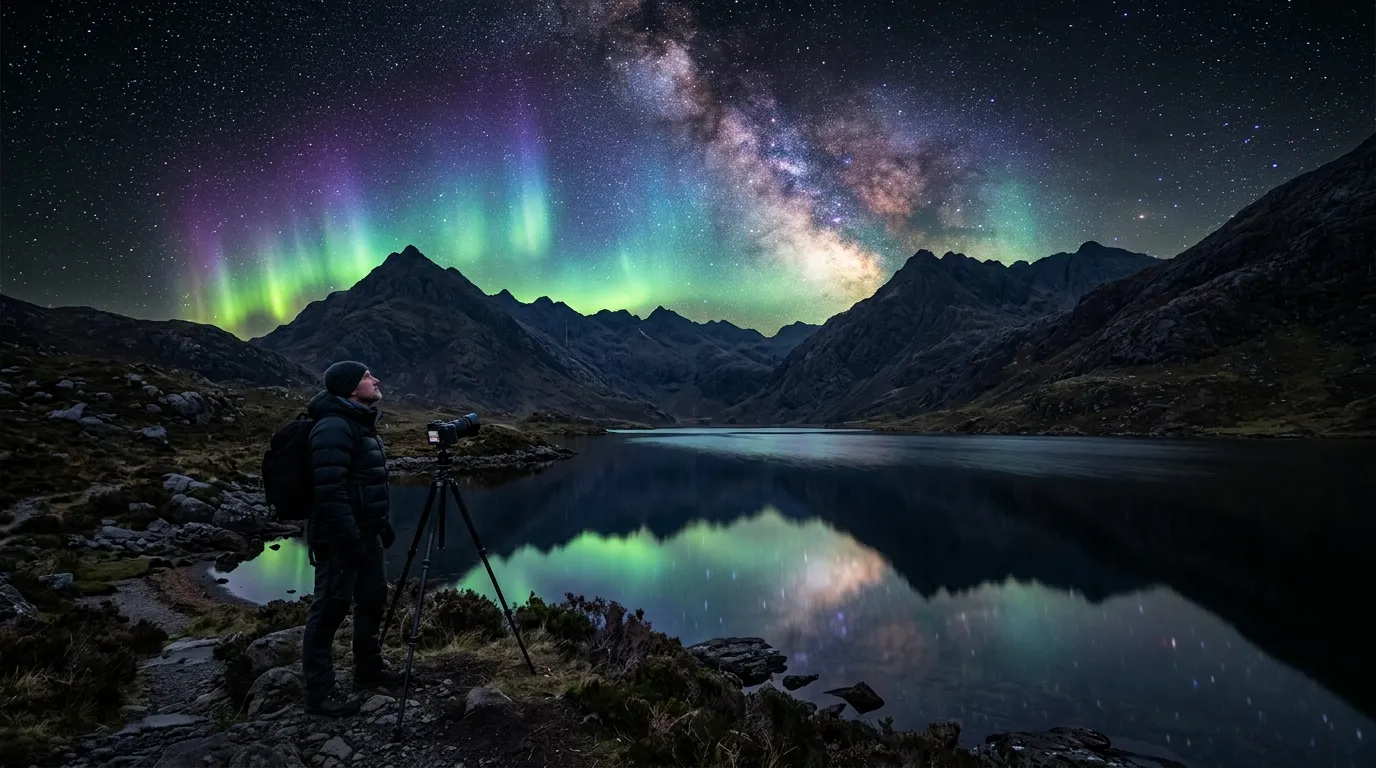
Isle of Skye Night Sky: Ultimate Guide to Stargazing & Aurora Hunting
Remote, rugged, and wonderfully isolated from urban sprawl, the Isle of Skye transforms into a realm of celestial wonder once the sun dips below the Atlantic horizon. Boasting some of the darkest skies in Europe, this Scottish island offers a pristine canvas for astronomers, photographers, and dreamers alike. Whether you are chasing the elusive glow of the Northern Lights, tracing the dusty spiral of the Milky Way across the cosmos, or simply marveling at countless visible stars with the naked eye, the Isle of Skye night sky delivers an unforgettable wilderness experience. Across the island, nine official Dark Sky Discovery Sites provide accessible gateways to the cosmos, while sweeping northern vistas and dramatic highland landscapes create the ultimate backdrop for astrophotography. Dive into this guide to discover the best locations, optimal seasons, and essential tips for experiencing the breathtaking nighttime magic of the Inner Hebrides.
Why the Isle of Skye Has the Darkest Skies in Europe
The Isle of Skye is widely celebrated not only for its dramatic daytime landscapes of jagged peaks and sea lochs but also for possessing some of the darkest, most pristine night skies in all of Europe.
Situated off the west coast of Scotland, the island benefits from a unique combination of high northern latitude, low population density, and strict environmental preservation. Unlike densely populated mainland areas plagued by the amber glow of urban development, Skye features vast expanses of rugged terrain completely removed from major industrial or residential light sources. This near-total absence of light pollution allows the isle of skye night sky to remain cloaked in deep, natural darkness, providing local residents and astrotourists alike with astronomical viewing conditions that are increasingly difficult to find elsewhere on the continent.
When weather fronts clear and high-pressure systems settle over the Inner Hebrides, the veil of artificial illumination lifts to reveal a staggering celestial display. Without the interference of urban glow, dense star fields emerge in breathtaking clarity across the expanse of the firmament. Observers stepping out into the Highland night are routinely greeted by a dazzling canopy where thousands of individual stars, distant nebulae, and faint constellations shine with piercing intensity. Most notably, the glowing band of the Milky Way arcs majestically across the heavens, its dusty lanes and stellar nurseries rendered with a vividness that leaves first-time visitors spellbound.
To achieve a "Milky Way Class" designation under the Dark Skye project, a site must be so devoid of light pollution that the majestic band of the Milky Way is clearly and vividly visible to the naked eye.
To harness and protect these exceptional environmental conditions, the local community and conservation organizations established the "Dark Skye project." This vital initiative is dedicated to preserving the island's pristine night skies while promoting sustainable astrotourism. As part of this effort, the project has formally identified and cataloged specific locations across the island that offer unobstructed horizons and maximum protection from stray light. These designated spots make it easier for stargazers, photographers, and amateur astronomers to navigate the island's dark terrain safely and locate prime viewing platforms for experiencing the cosmos in absolute tranquility.
By championing dark sky preservation, the Isle of Skye ensures that its breathtaking celestial heritage remains as enduring and awe-inspiring as its legendary geological formations.
Official Dark Sky Discovery Sites on the Isle of Skye
The Isle of Skye is home to nine official Milky Way Class Dark Sky Discovery Sites, strategically distributed across the island through the collaborative efforts of the Dark Skye project.
These designated locations were carefully chosen to provide stargazers with safe, accessible environments that feature minimal local light obstruction and vast horizons. Because the island is shaped by dramatic peninsulas and rugged topography, having official viewing spots helps astronomers and photographers navigate the terrain safely at night while enjoying prime conditions for deep-sky observation.
Managed to ensure public accessibility and parking, these nine sites span from the remote northern coastlines down to the wooded southern estates. Whether you are looking for sweeping northern horizons or sheltered inland clearings, the island's dark sky network offers diverse backdrops for observing constellations, planets, and the glowing band of our galaxy. The following regional breakdowns explore each designated location in detail, beginning with the dramatic vistas of the northwest and moving across the island's unique peninsulas and forest tracts.
Waternish Peninsula Hotspots
The northwest region of the Isle of Skye is home to some of the most remarkable dark sky environments in the British Isles, with the Waternish Peninsula standing out as a premier destination for nocturnal observation.
As you venture into the northwest to explore the peninsula's designated Milky Way Class Dark Sky Discovery Sites, you will encounter locations that benefit from exceptional horizons and a near-total absence of artificial glare. These spots have been carefully selected for their ease of access, safety, and lack of local light interference, allowing stargazers to witness the cosmos in breathtaking clarity.
The first of these exceptional locations is Trumpan Car Park, situated near the dramatic historic ruins of Trumpan Church. When you arrive, you will find a dedicated gravel parking area that provides a stable base to set up your equipment. The site opens up to vast northern and western horizons, making it an ideal vantage point for tracking constellations and sweeping galactic bands without obstruction from surrounding hills or modern developments.
Further down the coast lies the Stein Jetty Car Park, located in the picturesque conservation village of Stein. Parking is conveniently located near the waterfront, allowing visitors to step right out to the pier area. The reflective waters of Loch Bay enhance the celestial display on calm nights, mirroring the star-studded sky and creating a serene, highly atmospheric setting for quiet contemplation or long-exposure astrophotography.
The third Waternish hotspot is Knockbreck in Gillen, located further along the rural coastal tracks of the peninsula. This site offers an incredible sense of remote wilderness while remaining accessible via local single-track roads with designated passing places. Visitors should park respectfully near the designated access points, taking care not to block agricultural gates. Once settled, Knockbreck offers expansive skies looking out over the sea lochs, completely shielded from urban light sources, ensuring a truly immersive dark sky encounter.
Exploring these three Waternish locations grants you privileged access to some of the darkest, most pristine nightscapes in Europe.
Clan Donald Land and Sleat
Venture to the lush and historic Sleat peninsula in the southwest of the island to discover three of Skye’s most accessible and culturally rich official stargazing locations.
Located on the ancestral lands of Clan Donald at Armadale, this cluster of three designated Milky Way Class Dark Sky Discovery Sites represents a unique convergence of Scottish heritage and pristine nocturnal viewing. The standout location within this group is the grounds surrounding the Clan Donald Centre. Because this spot combines maintained accessibility with exceptional darkness, it has become a favorite hub for both amateur astronomers and casual evening visitors exploring the southern tip of the island.
The terrain around Armadale offers sweeping coastal vantages looking out across the Sound of Sleat toward the mainland. This positioning ensures that the southeastern horizon remains remarkably free from disruptive artificial light. Visitors setting up telescopes or cameras near the Clan Donald estate benefit from a sheltered microclimate compared to the more exposed northern peninsulas, while still enjoying skies dark enough to reveal dense constellations, shooting stars, and the glowing arch of the Milky Way during moonless nights.
Exploring the Armadale area allows stargazers to experience the raw magic of the Highland cosmos without having to navigate treacherous mountain passes in the pitch black.
Broadford, Kylerhea, and Kinloch Forest
Beyond the rugged coastlines of the northwest and the historic estates of the south, the eastern and southern corridors of the Isle of Skye offer uniquely sheltered and accessible environments for night sky observation.
Starting just outside the bustling village of Broadford, Camas na Sgianadin serves as one of the most accessible Milky Way Class Dark Sky Discovery Sites on the island. Located right off the main road yet shielded from direct urban glare by the surrounding topography, this coastal viewing spot looks out over the inner waters toward the mainland. The broad horizon here allows stargazers to capture sweeping panoramas of eastern constellations and the galactic core as it rises over the mainland hills. Because it requires very little strenuous hiking to reach, it remains a favorite for casual observers and photographers who want quick roadside access without sacrificing the pristine quality of Skye's nocturnal darkness.
Further south and tucked away through a dramatic mountain pass lies the Kylerhea Otter Haven Car Park, another designated Milky Way Class site. Nestled along the narrow strait separating Skye from the Scottish mainland, Kylerhea offers a remarkably dramatic dark sky backdrop framed by steep, tree-lined slopes and rocky shores. While the surrounding high ground slightly restricts the extreme edges of the horizon, it simultaneously blocks out stray coastal winds and minor light sources, creating a quiet, atmospheric pocket of absolute tranquility where the nocturnal silence is matched only by the brilliance of the overhead star canopy.
Completing this trio of eastern and southern havens is the viewing location at Kinloch Forest. Situated deeper inland within a vast woodland and moorland expanse, Kinloch Forest provides a completely different stargazing experience compared to coastal ledges and sea-level car parks. The dense tree cover immediately surrounding the area helps dampen ambient wind noise and protects equipment during long exposure photography sessions. Looking up through natural forest clearings, astronomers and astrophotographers can frame glittering constellations against towering pine silhouettes, making it an exceptional spot for creating dramatic, composition-rich nightscape imagery.
These diverse locations across Broadford, Kylerhea, and Kinloch Forest ensure that even when coastal weather proves challenging, sheltered eastern and southern alternatives remain ready to deliver breathtaking views of the cosmos.
Exploring these designated discovery areas reveals how each region of the island offers a distinct astronomical experience.
Can you see aurora in the Isle of Skye?
Yes, you can absolutely see the aurora on the Isle of Skye, making it one of the most magical experiences the Scottish Highlands have to offer.
Positioned at a northern latitude of roughly 57.5 degrees North, the Isle of Skye shares a parallel with some of the best stargazing and auroral zones in northern Europe. While Scotland is generally south of the prime auroral oval, high solar activity during geomagnetic storms can easily push the Northern Lights southwards into British skies. When the Kp index spikes, the remote and rugged landscapes of Skye provide a dramatic stage for the dancing ribbons of green, purple, and red light.
What truly elevates Skye as a premier destination for aurora hunting is its unique geography. The island features numerous uninhibited, north-facing horizons that look out directly across the open Atlantic Ocean toward the Arctic. Because there are vast stretches of water and virtually zero localized light pollution interrupting these northern viewing corridors, faint geomagnetic displays that might be washed out in urban areas become brilliantly visible here to the naked eye and through the lens of a camera.
To maximize your chances of witnessing this celestial phenomenon, you need to know exactly where to position yourself across the island's diverse terrain and understand the seasonal nuances of atmospheric displays, from winter's dancing lights to the ethereal summer phenomena that light up high-latitude twilights.
Prime Northern Lights Locations in Glendale
When it comes to witnessing the magical display of the Northern Lights in Scotland, Glendale stands undisputed as the premier hotspot on the Isle of Skye.
Positioned at a northern latitude of roughly 57.5 degrees North, Glendale offers an exceptional geographical advantage for aurora hunters. The area is defined by wide, expansive, and completely unobstructed north-facing vistas that gaze directly out across the cold waters of the Atlantic Ocean. Because there is virtually no artificial light pollution facing northwards toward the open sea, the horizon serves as a pristine canvas for catching the first faint glows and towering pillars of green and purple light during a geomagnetic storm.
Within the Glendale district, certain vantage points offer superior viewing conditions and have become local favorites for astrophotographers and night-sky enthusiasts alike. Upper Milovaig is widely celebrated for its elevated, panoramic perspectives over the loch and sea. For visitors seeking a dedicated base, establishments like Aurora Rural Retreats in Upper Milovaig provide a comfortable front-row seat to the heavens, allowing stargazers to monitor the skies right from the warmth of a prime viewing location before stepping out into the crisp Highland air.
A short drive further leads to another legendary local landmark: the Neist Point Car Park in Waterstein. Neist Point is already famous worldwide for its dramatic cliff edges and iconic lighthouse, but by night, it transforms into an amphitheater for celestial phenomena. The dramatic headlands frame the northern horizon perfectly, providing an awe-inspiring foreground of jagged cliffs and crashing waves underneath a dancing curtain of lights. While navigating the access road and the final walking path in the dark requires careful attention, the reward of watching the Aurora Borealis paint the sky above the Atlantic from this dramatic vantage point is an unforgettable Highland experience.
By targeting these specific coastal viewpoints in Glendale, aurora chasers maximize their chances of witnessing unforgettable light shows over the dark northern waters.
Winter Aurora vs. Summer Noctilucent Clouds
The Isle of Skye delivers dramatically different atmospheric displays depending on the time of year you visit.
While the island is universally celebrated for its autumn and winter stargazing, the seasonal cycle brings a fascinating shift in what illuminates the celestial sphere above the Inner Hebrides. Visitors traveling across different months will encounter two entirely distinct luminous spectacles: the elusive winter Aurora Borealis and the mesmerizing, high-altitude summer noctilucent clouds. Understanding the science, timing, and visual characteristics of each phenomenon ensures you bring the right expectations and preparation for your nocturnal expeditions.
During the depths of winter, the northern latitude of around 57.5 degrees North works in tandem with long periods of darkness to create prime conditions for viewing the Northern Lights. Solar wind interactions with Earth's magnetic field produce curtains of green, purple, and pink light that ripple across the northern horizon. Because winter nights are exceptionally long—stretching up to fifteen or sixteen hours of darkness around the winter solstice—astrophotographers and aurora hunters have ample opportunity to capture these displays during clear, crisp weather windows.
Phenomenon
Best Season
Atmospheric Cause
Visual Appearance
Aurora Borealis
Late Autumn to Early Spring
Solar wind particles colliding with Earth's magnetosphere
Dynamic curtains, arcs, and pillars of glowing green, purple, and red light
Noctilucent Clouds
Mid-Summer (June to July)
Ice crystals reflecting sunlight from the mesosphere at extreme altitudes
Electric blue and silvery, electric-like wave patterns glowing long after sunset
Conversely, the summer months bring a completely unique atmospheric marvel known as noctilucent, or night-shining, clouds. Because Skye experiences very short nights and extended twilight during June and July, traditional stargazing is heavily restricted by persistent daylight. However, these conditions are precisely what enable noctilucent clouds to form. Situated in the mesosphere at altitudes of roughly 80 kilometers, these ice crystal formations catch the sun's rays long after it has set below the horizon, casting an otherworldly electric blue and silvery illumination across the northern sky.
Whether you chase the magnetic storms of winter or the luminous high-altitude ice of mid-summer, Skye's skies never truly fail to put on a remarkable show.
Exploring the island's prime northern lookouts and understanding seasonal shifts will dramatically improve your chances of capturing an unforgettable light show.
Essential Tips for Photographing the Isle of Skye Night Sky
Stepping out into the Scottish Highlands after dark to capture the majesty of the cosmos requires far more than simply pointing a camera at the heavens.
Capturing the Isle of Skye's night sky is an unforgettable venture, but the island's raw and untamed coastal environment demands rigorous preparation. Because the weather systems rolling in from the Atlantic are notoriously volatile, clear skies can give way to heavy mist or sudden gales within a matter of minutes. Astrophotographers and stargazers must approach a night out on Skye with the mindset of an expedition, balancing precise technical camera knowledge with robust survival planning to ensure both safety and artistic success.
To master nightscape photography in this legendary landscape, you need to understand how to synchronize your outings with optimal seasonal windows, equip yourself against the biting Highland chill, and dial in your camera gear for crystal-clear stellar exposures. As we explore the essential strategies for optimal seasons, safety gear, and camera settings, you will discover everything required to turn your nocturnal vision into breathtaking reality.
Optimal Seasons and Weather Tracking
Timing is everything when planning a successful astrophotography or stargazing expedition on the Isle of Skye.
To experience the absolute darkest skies, your primary planning window should fall between the months of October and March. During these winter months, the nights on the Isle of Skye are significantly longer and noticeably darker compared to the brief twilight periods of the Scottish summer. This extended darkness provides prime viewing conditions for deep-space objects, distant galaxies, and the brilliant arch of the Milky Way, provided the weather cooperates.
Beyond seasonal planning, synchronizing your trip with the lunar cycle is critical for maximizing sky contrast. You should aim to schedule your observation nights around the New Moon phase, when the moon is completely unilluminated or absent from the night sky. Even a half-moon can wash out faint celestial details, whereas a New Moon yields the inky, star-studded backdrop necessary for spotting elusive nebulae and faint aurora displays.
Because maritime weather in the Scottish Highlands can be notoriously fickle, tracking real-time meteorological conditions is a daily necessity. Utilizing specialized aurora forecasting apps, such as Glendale-specific aurora alerts, Glendale Live widgets, and global geomagnetic trackers like Glendale Space Weather Prediction Center models, will help you gauge solar activity levels. Pair these tools with local Scottish meteorological radars and cloud-cover forecasts to strategically dodge incoming Atlantic storm systems and locate clear pockets of sky across the island.
Mastering the timing of moon phases and weather windows ensures you will not be caught out by sudden Highland cloud cover.
Highland Clothing and Survival Gear List
Preparing for a night out under the pristine skies of the Isle of Skye requires serious attention to clothing and equipment to combat the biting Highland cold and unpredictable weather.
Stargazing and astrophotography on the Isle of Skye often demand standing completely still for hours in freezing temperatures, damp air, and fierce coastal winds. Even during the milder months, the drop in temperature once the sun sets can be severe, making proper layering and survival gear absolute necessities for a safe and comfortable experience. Without the right preparation, the elements can quickly cut your session short or lead to dangerous cold-related injuries.
Your primary defense against the elements is a multi-layered clothing system starting with moisture-wicking thermal base layers, followed by insulating mid-layers like heavy fleece or down, and capped with completely waterproof and windproof outer shells. Do not overlook your extremities: thick merino wool socks, insulated winter boots, and wind-resistant gloves are vital because your fingers and toes will lose warmth first when you are operating camera equipment or holding binoculars.
Equally important to your personal comfort is protecting your night vision and respecting fellow stargazers by avoiding white light. A specialized red-light headtorch is an indispensable tool for navigating dark terrain, adjusting your tripod, or checking camera dials without blinding yourself or ruining the dark adaptation of your eyes. Red light has a longer wavelength that does not disrupt your night vision, allowing you to seamlessly transition between looking at your gear and looking up at the deep cosmos.
Red-light headtorch: Essential for preserving night vision and preventing light pollution while setting up gear in pitch darkness.
Thermal base layers: Merino wool or synthetic moisture-wicking tops and bottoms to keep your skin dry and warm.
Windproof and waterproof outer jacket: GORE-TEX or equivalent hardshell to block fierce Atlantic gales and sudden rain showers.
Insulated winter boots: Rated for sub-zero temperatures, paired with thick thermal socks to combat freezing ground frost.
Chemical or rechargeable hand warmers: Crucial for keeping fingers agile when adjusting delicate camera focus rings in the cold.
Equipping yourself with these specialized items ensures you can focus entirely on the breathtaking celestial views above rather than the biting chill below.
Camera Settings for Clear-Sky Astrophotography
Capturing the breathtaking expanse of the Isle of Skye night sky requires moving away from automatic camera modes and taking full manual control.
To successfully photograph the celestial wonders above Skye, you need to configure your camera settings specifically for low-light astrophotography. Start by mounting your camera on a heavy, ultra-sturdy tripod. The coastal winds sweeping across the Scottish Highlands can ruin an exposure with even the slightest vibration, making a solid base non-negotiable. Switch your camera and lens to manual focus, and use your camera's live view screen to zoom in on a bright star or distant light source, carefully adjusting the focus ring until the star appears as a pinprick.
Always keep spare camera batteries in an inner jacket pocket close to your body heat. The freezing highland temperatures will drain lithium-ion batteries extremely quickly, and you do not want your session cut short by power failure.
Next, set your lens to its widest possible aperture, ideally f/2.8 or lower, to allow as much light as possible to hit the sensor in a short timeframe. Set your shutter speed between 15 and 25 seconds; anything longer than 25 seconds will result in star trailing due to the Earth's rotation. Finally, adjust your ISO between 1600 and 3200 depending on your camera's sensor capabilities and the ambient darkness of your specific shooting location. Always shoot in RAW format to retain maximum dynamic range for post-processing the intricate details of the Milky Way or the glowing green curtains of the aurora.
Mastering these technical fundamentals will ensure your images reflect the true, awe-inspiring magnitude of Skye's pristine nocturnal landscapes.
Let us dive into the core tactical elements needed to conquer the elements and master clear-sky astrophotography on Skye.
Witnessing the Isle of Skye night sky is an awe-inspiring journey that connects you deeply with the raw, untamed beauty of the Scottish Highlands. By venturing out to the island's nine official Dark Sky Discovery Sites—whether gazing across the water from the Waternish Peninsula or tracking winter auroras in Glendale—you open yourself up to some of the clearest, darkest stargazing opportunities in all of Europe. Planning your adventure around the lunar cycle and checking local weather forecasts will ensure you capture the Milky Way in all its glory or catch a mesmerizing display of the Northern Lights. As you explore these remote dark-sky locations, remember to preserve the fragile wilderness by practicing Leave No Trace principles, using red-light headlamps to protect your night vision, and respecting local Highland communities. Prepare your gear, wrap up warm, and let the magnificent Skye cosmos leave you spellbound.